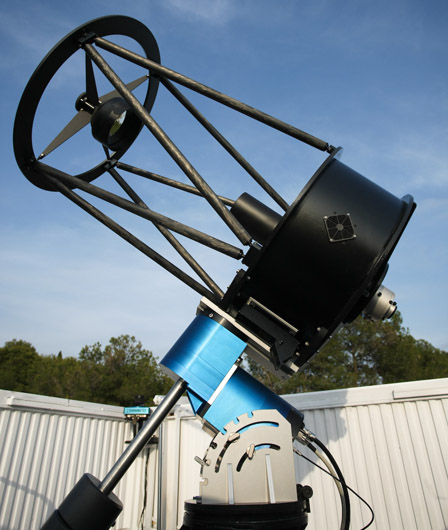
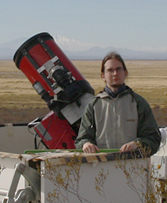
Ještě doplním, že nová kometa dostala jméno C/2007 K5 (Lovejoy). Tady je popis přímo od Terry Lovejoye:
Discovery of Comet C/2007K5
First of all a big thank you to all your kind words

After a discovering Comet C/2007 E2 on March 15 this year, I am happy
to report finding another Comet just 2 months later! Naturally I am
elated, especially since this one was a much tougher and challenging
find, proving my techniques are working.
This particular comet (designated C/2007K5) was found as a small
faint but still rather obvious blue-green haze in my images from the
evening of May 26. My initial estimate is mag 13, but I admit I have
not attempted more precise photometry and visually the comet could
well be brighter. Interestingly the discovery was made during a
bright waxing moon and in the evening sky where moderate light
pollution prevails. On the evening I had both cameras (a Canon 300D
+ Canon 350D) mounted the usual way with the 300D pointed towards -18
declination and the 350D pointed towards declination -11. This
allows me to image 13 degree wide sweep of sky from west to east.
Some 12 individual starfields were covered with both cameras, with 12
subexposures of 90 seconds for each starfield.
The following day, I downloaded the images from my 300D and ran them
through the usual automated processing steps (IRIS is used for this).
This processing step outputs 2 images per starfield effectively
separated by 10 minutes so that moving objects like comets can be
identified. By 'blinking' the 2 images one can see objects like
asteroids and comets bobbing backwards and forwards. On examining
the first image I almost immediately noticed a moving small hazy
object with a distinctive blue green colour typical of many comets.
I knew I had something for sure, and notified a number of other for
confirmation of a possible comet.
Confirmation came on May 28 when both John Drummond and I made
followup observations, which were then sent to Dan Green at CBAT.
Further followup was obtained on May 29 by Rob McNaught before an
official circular (IAUC 8840) announced the new comet as C/2007 K5.
Interesting, C/2007 K5 required less than 20 hours of actual
searching in contrast to the estimated 1400 hours for C/2007 E2.
The comet itself appears to be quite faint, and will problably remain
that way, but a comet none-the-less. Further astrometry is require
to calculate an orbit and once this is done the comet will be named.
Terry